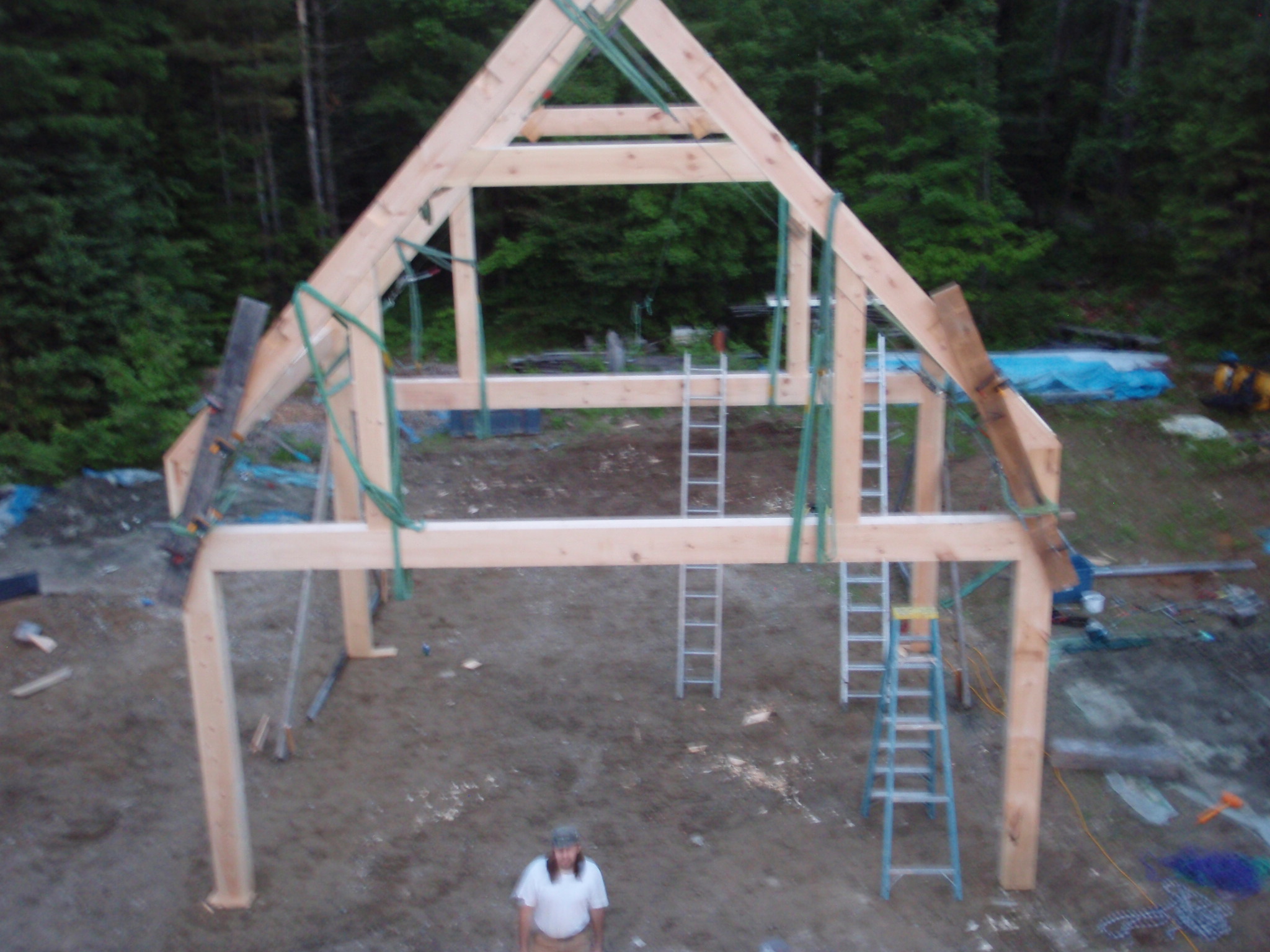
Pine Frame Assembly: Wall and Roof Structure for Small Cabins
Platform framing with pine lumber is the most common structural approach for cabin and small building construction in rural Poland. The method relies on horizontal platforms at each floor level, with wall studs spanning between sill and top plates. This reference covers the sequence of assembly, member selection, and connection details relevant to single-storey cabin projects.
Foundation Interface and Sill Plate
The sill plate — the lowest horizontal timber in the wall frame — rests directly on the foundation. In Polish practice, this member is typically 63 × 145 mm or 63 × 195 mm Scots pine graded C24 under EN 338. Because the sill sits in service class 2 or 3 (as defined by EN 1995-1-1), preservative treatment to use class UC3 (above ground, exposed to weather) is required under EN 335.
A polyethylene membrane or sill gasket between the concrete and timber prevents capillary moisture transfer. Anchor bolts, typically M12, are set at 1.2 m centres and not closer than 300 mm to a plate joint or corner.
Corner Post and Wall Stud Layout
In platform-frame construction, corner posts are built up from three 45 × 145 mm studs to provide internal and external nailing surface. Single studs at 600 mm centres on-centre are standard for non-load-bearing walls; load-bearing walls use 400 mm spacing with C24 material. Door and window openings require doubled studs at each jamb and a header beam sized for the span.
Stud-to-Plate Connections
Toenailing with 3.5 × 90 mm ring-shank nails (two per side at sill, two per side at top plate) is the standard site method. For higher wind or snow uplift — common in the southern Polish upland regions — metal framing anchors per EN 14545 offer a calculable connection capacity. The anchor manufacturer's specification sheet should be referenced for the installed nail count.
Top Plate and Wall Head
A double top plate of 45 × 145 mm spans across studs and transfers concentrated loads from above. Plate laps occur at minimum 600 mm from stud centre lines to avoid weak points. The upper plate can also serve as a ledger for ceiling joists, which are face-nailed to it and toenailed into the rafters at the bearing point.
Rafter Assembly
For simple gable roofs on cabins, common rafters at 45 × 120 mm or 45 × 145 mm are cut to pitch angle and notched with a bird's mouth where they rest on the top plate. The depth of the bird's mouth should not exceed one-third of the rafter depth. A ridge board — typically 25 mm thick, same depth as the rafters — holds pairs of opposing rafters.
Collar Ties and Ridge Beams
Collar ties at 45 × 95 mm, placed at the upper third of rafter height, reduce outward thrust on the walls. A structural ridge beam — a solid or glued-laminated member sized by calculation — eliminates the ridge board and allows an open ceiling without collar ties, a common design choice for cabin interiors.
Assembly Sequence on Site
- Install and level sill plates; verify square by checking diagonals.
- Build corner posts off-site if possible; stand and brace temporarily.
- Frame wall panels flat on the platform, then raise and nail through the sill plate.
- Install doubled top plate, lapping corners and openings.
- Install ceiling joists or floor joists for upper levels before raising opposing walls.
- Cut and set ridge board or ridge beam; install opposing rafter pairs alternately.
- Fit collar ties and any structural ridge hangers before removing temporary bracing.
- Install sheathing to the walls and roof deck before proceeding to weatherproofing layers.
Temporary Bracing
Walls are unstable until sheathing or diagonal let-in bracing is fixed. Site conditions in Poland — particularly spring wind events in the Mazovian lowlands and autumn gusts in the Carpathian foothills — make temporary bracing a practical safety step rather than an optional one. 50 × 150 mm diagonal props at roughly 45° from the foundation anchor to the top plate hold walls plumb until sheathing is complete.
References and Further Reading
- EN 1995-1-1 (Eurocode 5) — European Committee for Standardisation
- Lasy Państwowe (State Forests Poland)
- Timber Trade Federation — Structural Timber Resources